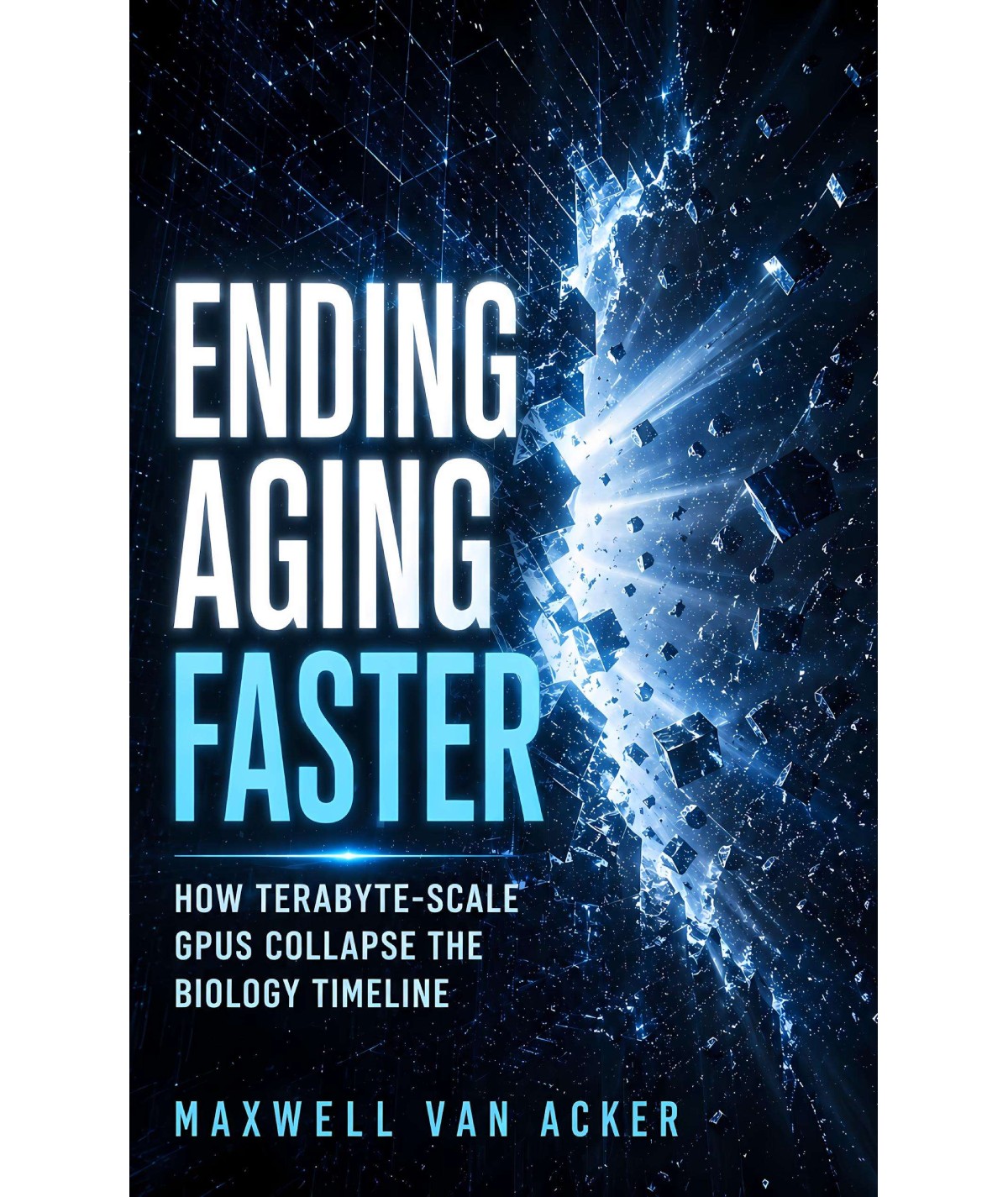
For decades, aging has been treated as one of biology’s most complex and intractable problems. Despite enormous scientific effort, progress has been slow, fragmented, and uncertain. Many assume this reflects the inherent difficulty of the problem. This book presents a different explanation: aging research has been constrained less by biology than by computation.
Ending Aging Faster argues that aging is best understood as a systems coordination problem unfolding across time, scale, and biological state. Modern biology already possesses extensive knowledge about the mechanisms of aging, from genomic instability to metabolic drift. Yet this knowledge remains scattered across models that cannot be integrated into a coherent whole. The result is a field rich in data but poor in unified understanding.
The central claim of this book is narrow but consequential: memory scale determines the speed of scientific progress. When entire systems can be held in active computational memory, models stop behaving like sketches and begin behaving like systems. Whole biological states can be simulated continuously, historical state can be preserved, and interactions across molecules, cells, tissues, and time can be explored together rather than in isolation.
Drawing on examples from weather forecasting, genomics, aerospace engineering, and modern machine learning, the book shows how major scientific advances often followed the crossing of memory thresholds. In each case, progress accelerated when entire systems could be retained, updated, and interrogated simultaneously. Biology may be approaching a similar transition.
Rather than predicting miracles or promising immortality, this work focuses on constraints. It explains why raw computing power alone did not transform biology, why distributed systems often distort biological coherence, and why large unified memory systems may change research workflows. It also outlines the limits of computation, including measurement uncertainty, incomplete biological knowledge, and the continuing necessity of real-world experiments.
The book is written for readers interested in the intersection of biology, artificial intelligence, and scientific infrastructure. Engineers, scientists, technologists, investors, and intellectually curious general readers will find a structured explanation of how advances in computation could reshape one of humanity’s oldest problems.
Ending Aging Faster does not argue that aging will be solved quickly or easily. Instead, it offers a careful examination of why progress has been slow and why the next phase of research may move much faster.