
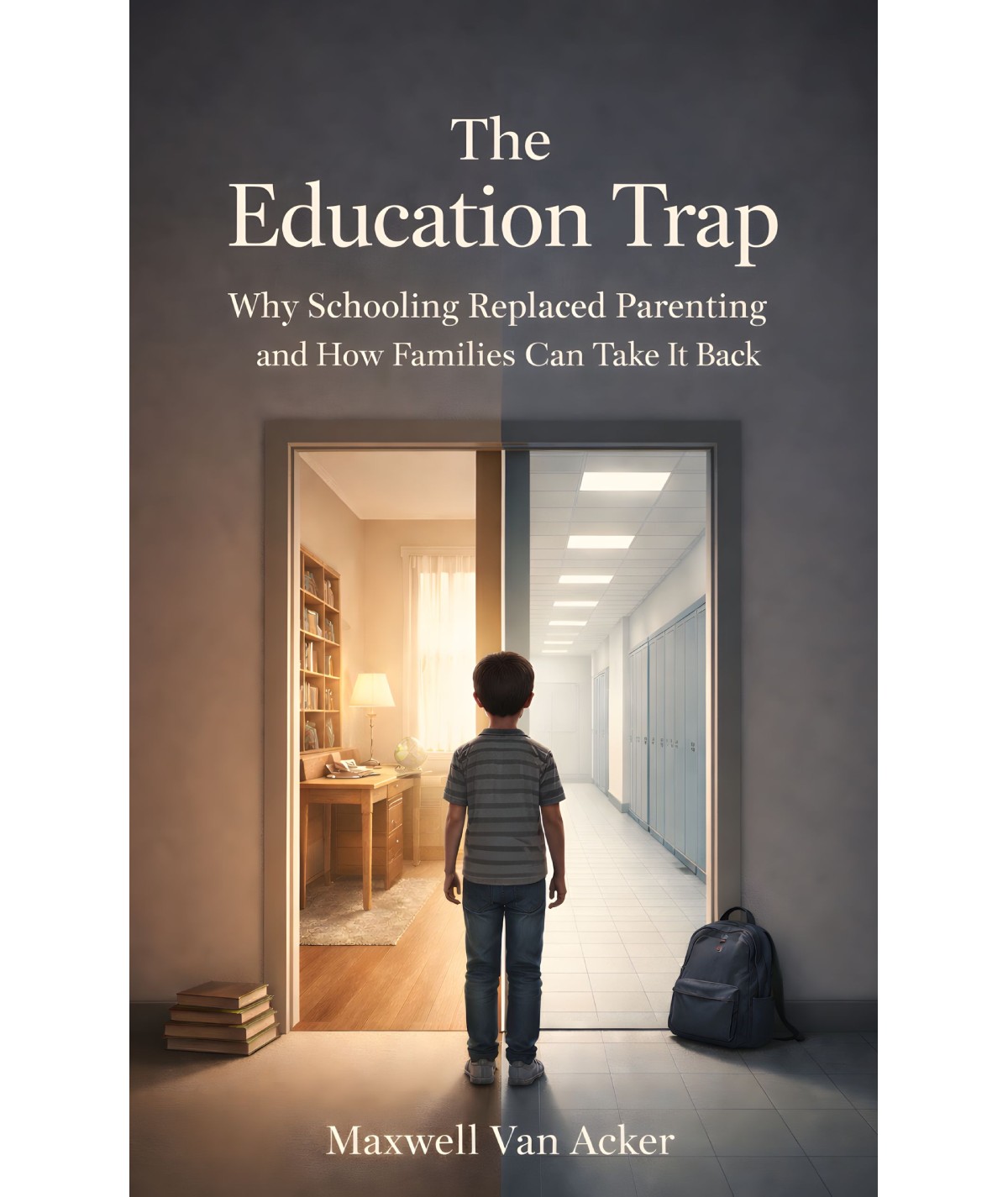
Most parents assume school is where education happens.
Children spend six or seven hours a day inside classrooms designed to manage large groups efficiently. Grades track performance, schedules structure the day, and standardized lessons promise progress. Yet many families sense a quiet gap between what school provides and what children actually need.
The Education Trap explores how modern schooling gradually replaced responsibilities that once belonged to families. Without anger or ideology, this book examines how education systems evolved to prioritize order, efficiency, and measurement, and how those priorities still shape children’s daily experiences today.
The book shows how school systems often reward compliance over curiosity, grades over growth, and coverage of material over real understanding. Children learn to work for approval rather than mastery, to follow schedules rather than questions, and to measure success by external evaluations. These patterns are rarely intentional; they emerge from systems designed to scale education across large populations.
Parents often sense that something is not quite right, yet feel unable to change course. The book explores the pressures that keep families in place: lack of time, fear of social judgment, concern about qualifications, and anxiety about children’s futures. These forces create a powerful sense of inevitability around schooling, even when it does not fit a child well.
Rather than attacking schools or educators, The Education Trap presents a compassionate view of the system. Teachers work within constraints they did not design, and parents often feel overwhelmed by modern demands. The problem is not individuals but structures that prioritize efficiency over human development.
The book also examines what children often miss inside institutional education: curiosity that fades under constant evaluation, attention fragmented by screens and schedules, and practical skills that rarely appear in textbooks. It considers how identity and motivation can shift away from family influence toward institutional approval and peer expectations.
In the second half of the book, the focus turns to realistic alternatives. The author describes what effective homeschooling actually looks like in practice: short, focused academic sessions combined with reading, projects, and real-world experiences. Contrary to common assumptions, homeschooling often requires less time than traditional schooling while allowing deeper learning and stronger family relationships.
The book addresses common concerns about homeschooling, including socialization, academic standards, and long-term opportunities. It shows how children can develop social confidence through mixed-age relationships and real-world interactions rather than relying entirely on peer-based environments.
This book is written for:
- Parents questioning whether school is the right fit
- Families considering homeschooling
- Educators interested in alternative approaches
- Readers concerned about modern childhood
The Education Trap is not a call for rebellion but for responsibility. It argues that education works best when families play a central role in shaping children’s learning.
At its core, this book asks a simple but important question:
Who is really raising our children?