
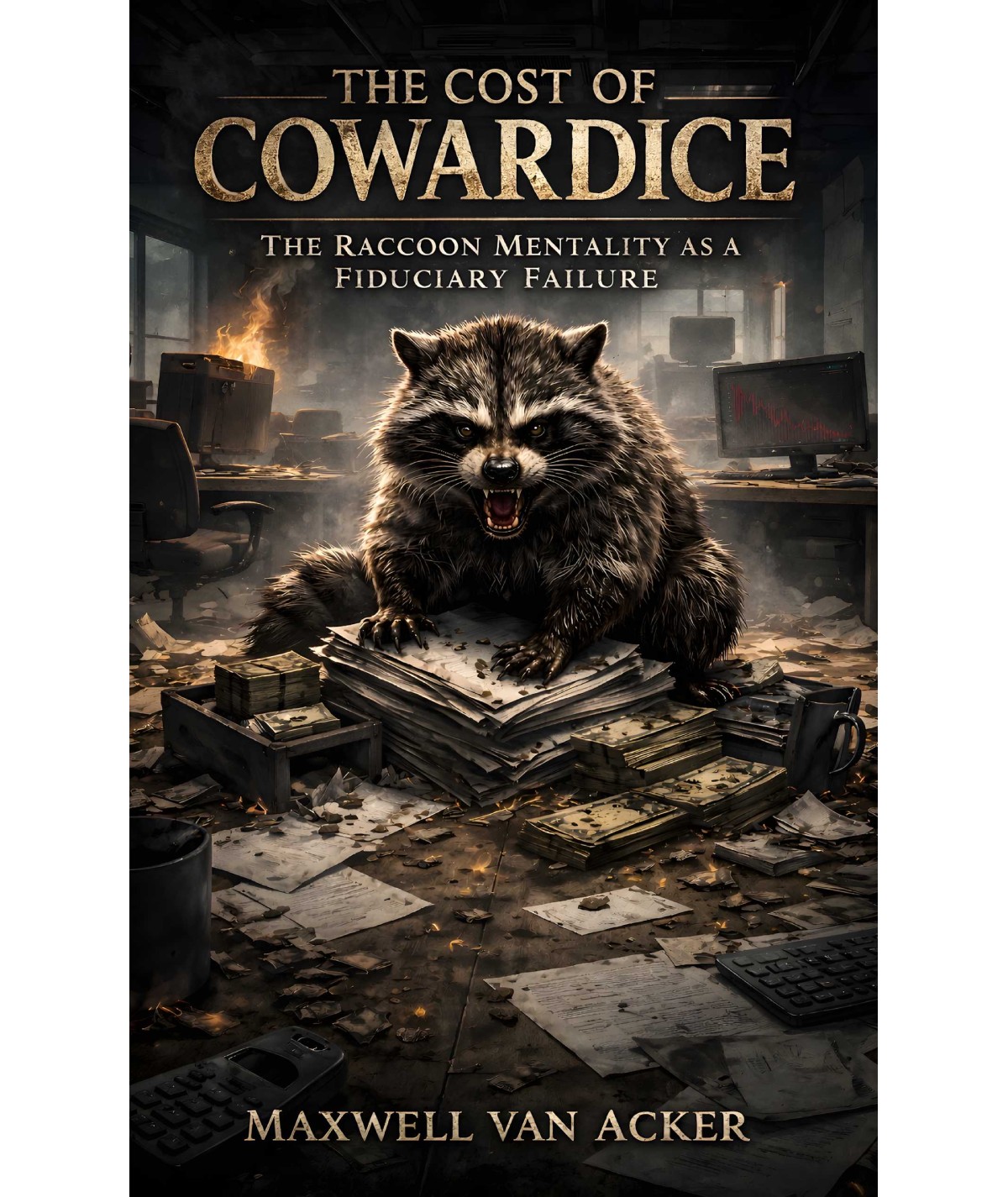
Some companies fail quickly and visibly. Others fail slowly while continuing to operate, drawing salaries and consuming capital long after their future has already closed. The Cost of Cowardice examines the second kind of failure, the quiet stagnation that emerges when leadership refuses to confront reality.
At the center of this book is a detailed case study of a technology company that remained in business for more than two decades while producing results far below industry benchmarks. With revenue per employee a fraction of that of comparable firms and growth opportunities repeatedly missed, the evidence accumulated year after year. Yet intervention never came.
This book argues that persistent underperformance is rarely the result of bad luck. It is more often the result of governance failure, a pattern in which executives avoid disruption, investors delay difficult decisions, and organizations adapt to mediocrity instead of correcting it.
Through careful analysis, The Cost of Cowardice explores:
- How “zombie companies” survive long after they should have been restructured
- Why venture capital oversight often fails to enforce accountability
- How vanity metrics conceal economic reality
- Why high-performing employees are trapped inside low-performing systems
- How median performance becomes an invisible ceiling
- Why delayed restructuring eventually becomes unavoidable
- How automation and speed have reset the economics of modern companies
Rather than presenting abstract management advice, this book treats corporate performance as a measurable system. Metrics such as revenue per employee, output concentration, and comparative velocity serve as diagnostic tools to distinguish temporary setbacks from structural failure.
The book is written primarily for:
- Venture capital investors
- Limited partners
- Founders and executives
- Corporate directors
- Operators responsible for scaling organizations
- Readers interested in business governance and organizational decline
The Cost of Cowardice is not a memoir or a motivational book. It is an analytical record of how delay compounds losses and how inaction becomes a decision with measurable consequences.
In an era when markets move faster than ever and automation continues to lower the cost of execution, hesitation has become one of the most expensive mistakes an organization can make. This book examines what happens when that mistake is repeated for years, and why accountability ultimately becomes unavoidable.