
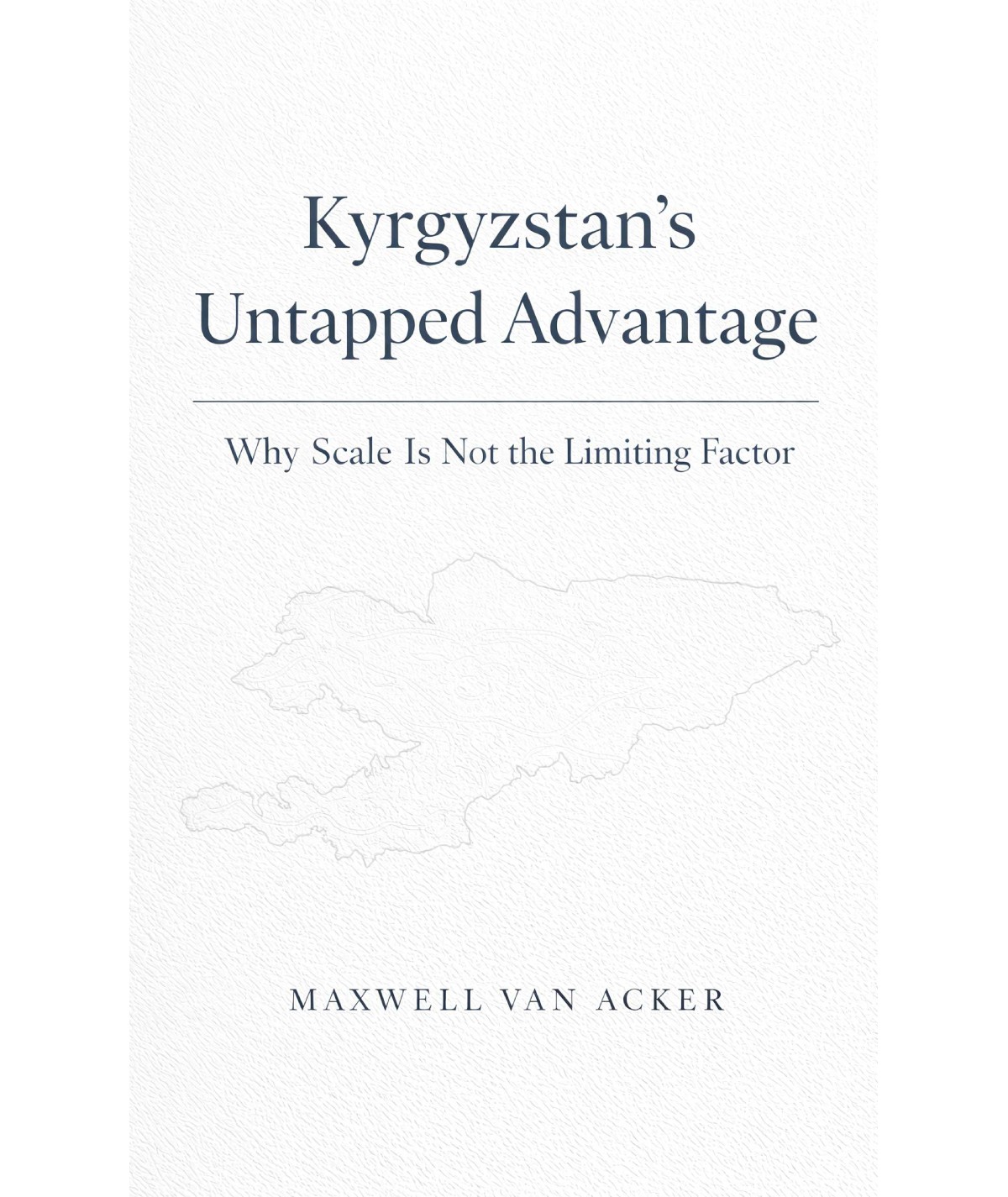
Why do some countries remain economically constrained even when viable opportunities exist?
Kyrgyzstan’s Untapped Advantage examines a question rarely addressed directly: why population size is often mistaken for economic destiny. While development strategies frequently assume that large labor markets and industrial scale are necessary for growth, this book argues that modern service economies operate under different structural rules.
Rather than presenting a reform agenda or policy blueprint, this work provides a careful structural analysis of how service-based economic systems actually function. It shows how coordination costs, incentive alignment, and institutional behavior shape national outcomes more reliably than traditional measures such as population size or industrial capacity.
The book explains how technology-enabled services have become the default growth surface of the global economy. It describes why manufacturing is no longer the universal development path it once appeared to be, and why attempts to copy large-country models often fail in smaller states. The analysis demonstrates how service economies scale through process replication and coordination rather than physical expansion.
Using Kyrgyzstan as a concrete case study, the book documents structural conditions that already exist: basic educational capacity, flexible labor markets, digital literacy, and geographic neutrality. It shows how these conditions form a sufficient baseline for participation in global service markets without requiring large-scale transformation.
The work also examines institutional reality. Governments, donors, and large organizations often avoid opportunities with clear aggregate benefits because risks and incentives are unevenly distributed. The book explains why obvious economic upside is frequently left unrealized and why structurally viable models rarely emerge spontaneously.
A central theme is that technology alone does not drive development. Tools, funding, and programs cannot produce lasting results without coordination and binding incentives. Sustainable outcomes emerge only when services are treated as infrastructure and institutional incentives align with long-term stability.
This book is written for:
- Policymakers and government staff
- Development professionals
- Economists and researchers
- Institutional strategists
- Readers interested in small-state economics
Kyrgyzstan’s Untapped Advantage is not a political manifesto or a development plan. It is a disciplined analytical record of structural conditions that make certain outcomes possible.
By separating structural reality from narrative assumptions, the book provides a clear framework for understanding economic opportunity in small states, and why scale is not the limiting factor.