
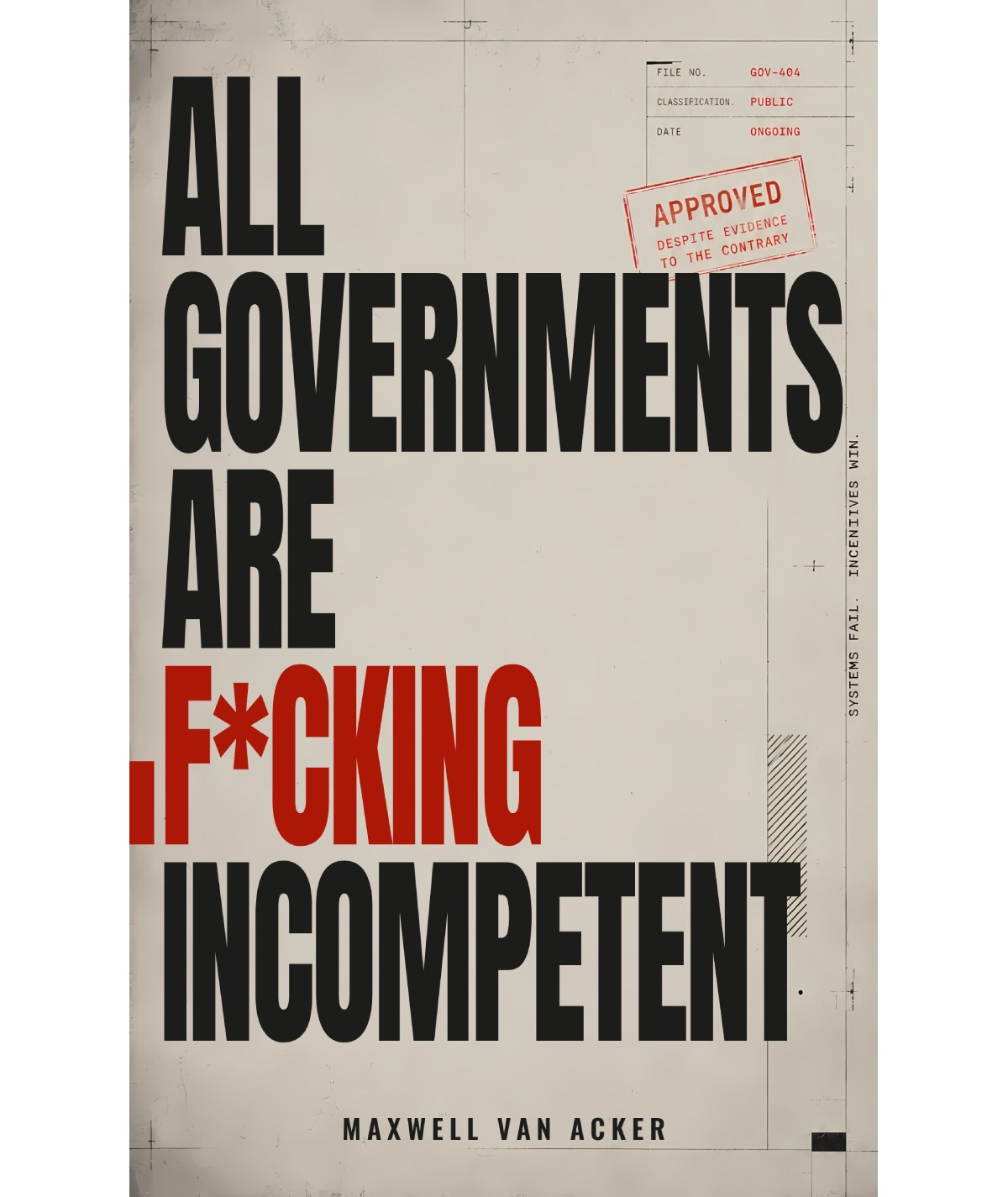
Most government failures are not mysterious.
The problems are visible. The data exists. The solutions are often already known. Yet the same patterns repeat across countries, administrations, and political ideologies: delayed responses, symbolic reforms, weakened enforcement, endless studies, policy reversals, and crises that escalate long after warning signs were obvious.
All Governments Are F*cking Incompetent examines why this happens.
Rather than treating political dysfunction as the result of individual corruption, intelligence, or party affiliation, the book approaches government failure as a structural problem. It argues that modern institutions frequently operate under incentive systems that reward caution, image management, short-term stability, and conflict avoidance over decisive long-term problem solving.
The book explores how administrative inertia develops and sustains itself over time. It analyzes the relationship between bureaucracy, public backlash, media amplification, electoral pressure, procedural complexity, and institutional risk management. Policies are not evaluated solely on whether they solve problems. They are also filtered through questions of political survivability, public reaction, implementation risk, and short-term disruption.
This creates a predictable pattern:
- Problems are acknowledged early but addressed late.
- Effective solutions are weakened before implementation.
- Enforcement becomes secondary to public messaging.
- Partial reforms create the appearance of action without resolving root causes.
- Failed or diluted policies are later used as evidence that meaningful action “does not work.”
- The cycle repeats.
The book also examines why governments occasionally act quickly and decisively — and why those moments are rare. It explores the conditions required for rapid state action, including concentrated authority, visible urgency, simplified objectives, and reduced procedural friction. By contrasting these moments with normal bureaucratic behavior, the book highlights the structural forces that slow or prevent effective governance under ordinary conditions.
Importantly, this is not a partisan argument. The analysis is intentionally broad and systemic. The book does not claim that one ideology, nation, or administration possesses a unique monopoly on incompetence. Instead, it argues that many modern governments converge toward similar operational behaviors because they face similar institutional incentives and constraints.
The result is a political environment where maintaining short-term stability often becomes more important than solving underlying problems. Delayed decisions become safer than disruptive reforms. Symbolic action becomes safer than measurable outcomes. Public perception becomes easier to manage than long-term structural change.
Written in a direct, analytical style, this book is intended for readers interested in:
- Political systems and governance
- Bureaucracy and institutional behavior
- Public policy and policy failure
- Administrative inefficiency
- Political incentives and decision-making
- State capacity and governance theory
- Media influence on public administration
- Long-term societal stagnation
Rather than offering simplistic solutions or ideological slogans, the book focuses on explaining the mechanisms behind recurring governmental failure. Its goal is not outrage for its own sake, but clarity: to examine how complex institutions behave under pressure, why obvious problems persist for decades, and why systems that appear powerful often struggle to produce effective outcomes.
For readers frustrated by repeated crises, endless delays, and policies that seem designed more to manage appearances than resolve problems, this book provides a structured framework for understanding why these patterns continue to emerge — regardless of who is in power.