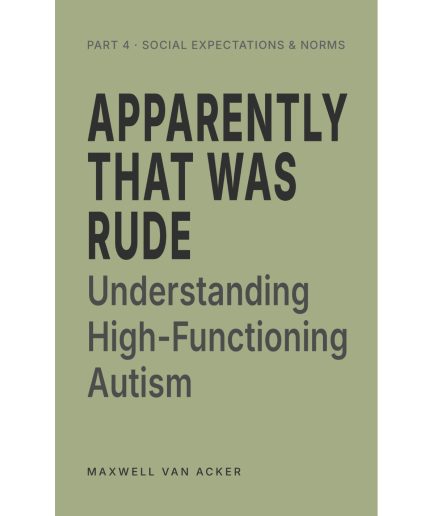
Most people learn social expectations indirectly. They absorb unwritten rules through repetition, observation, emotional feedback, and social correction. For many autistic individuals, however, these systems remain unclear, inconsistent, or invisible; even when they are highly intelligent, observant, and motivated to communicate well.
Apparently That Was Rude, Part 4 approaches this problem from a different angle. Instead of relying on intuition-based advice, personality coaching, or abstract psychology, the book treats social interaction as a structured system that can be analyzed, identified, and learned.
This volume focuses specifically on social norms: the expected behaviors, scripted responses, invisible boundaries, and interaction patterns that shape everyday communication. The book examines how people maintain social stability, avoid friction, enforce expectations, and interpret behavior inside ordinary social environments.
Each section follows a highly structured format. Readers are shown:
- The function of a behavior
- The social logic behind it
- Expected signals and responses
- Minimum viable compliance behaviors
- Common autistic failure patterns
- Disengagement signals and stopping points
- Situations where the rule does not apply
Rather than telling readers to “be more confident” or “read the room,” the book explains concrete interaction mechanics. Topics include recognizing when intent is ignored in favor of outcomes, identifying routine social scripts, recovering after unintentionally violating a norm, understanding partial compliance, navigating asymmetrical power expectations, and recognizing how predictability shapes group behavior.
The writing is intentionally direct and analytical. Emotional interpretation is minimized in favor of observable behavior, repeatable patterns, and practical application. Social interaction is presented not as moral judgment, but as a system of coordination that many people navigate automatically and others must consciously study.
This book is especially relevant for:
- Autistic adults seeking clearer explanations of social behavior
- Teenagers entering workplaces, universities, or adult social environments
- Therapists and autism specialists
- Educators and support staff
- Family members trying to better understand communication differences
- Readers interested in behavioral systems and interpersonal dynamics
The goal of the book is not to encourage masking, imitation, or loss of identity. Instead, it aims to reduce confusion by making implicit expectations visible. Understanding a social system does not require unconditional agreement with it, but recognizing how it operates can significantly reduce unnecessary conflict, exclusion, and misunderstanding.
Part 4 of the series concentrates on the social expectations and norms that influence daily interaction in schools, workplaces, families, friendships, and public life. It is designed as both a reference guide and a practical framework for readers who prefer structured explanations over ambiguous social advice.
For readers who have often been told they were “rude,” “too direct,” “defensive,” or “difficult” without understanding exactly why, this book provides a systematic explanation of the invisible rules many people assume everyone already knows.