Many social rules are never spoken aloud.
People are expected to recognize when disagreement is acceptable, when silence is safer than explanation, when honesty is welcomed versus discouraged, and when a group values emotional stability more than factual accuracy. Most people absorb these patterns implicitly over time. Others do not.
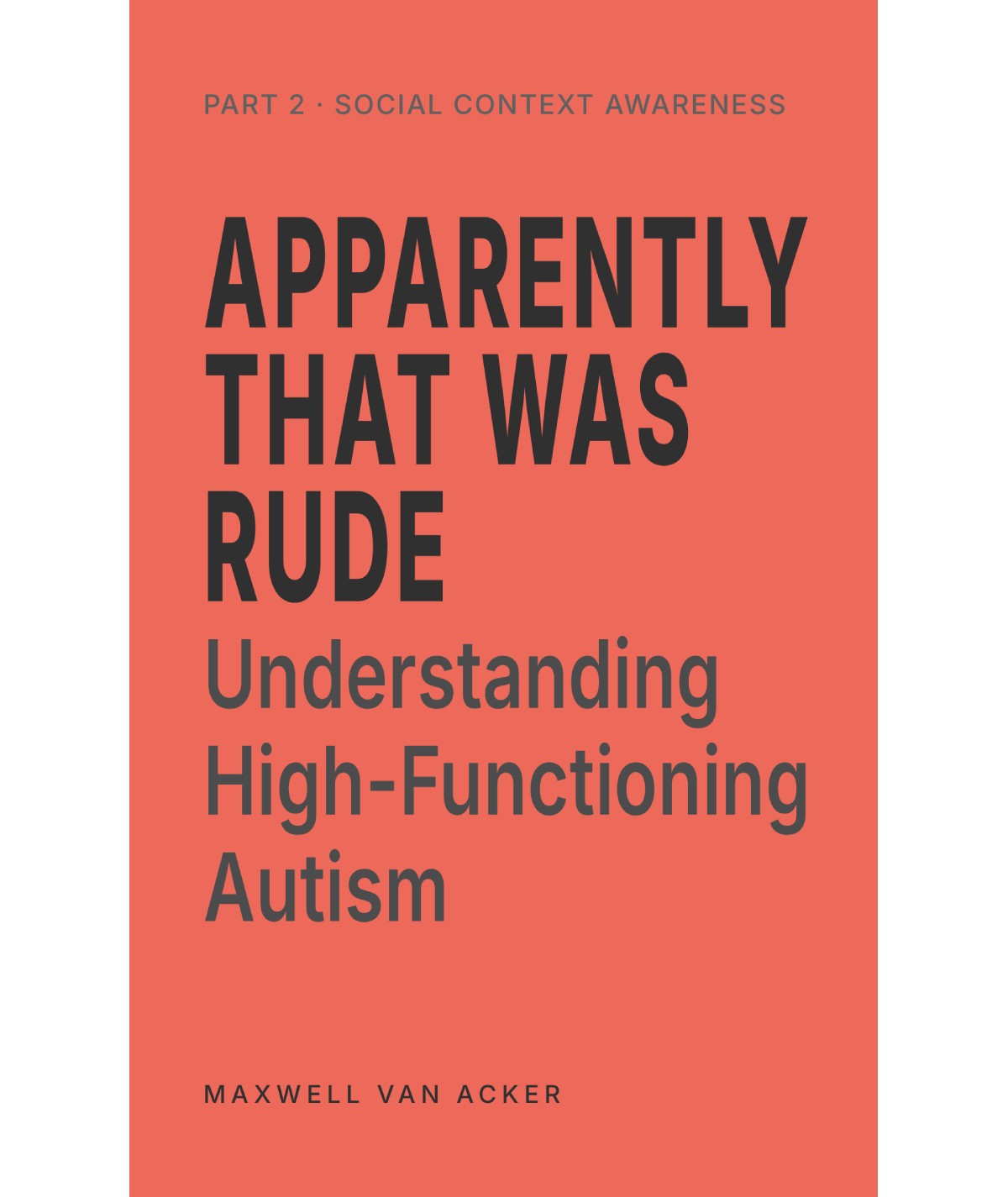
Apparently That Was Rude: Understanding Social Communication in High-Functioning Autism — Part 2: Social Context Awareness explores the hidden structures behind everyday interaction. The book examines how social environments operate, how context changes expectations, and why certain behaviors are rewarded or punished depending on timing, hierarchy, group dynamics, and emotional conditions.
Rather than presenting generic social advice, this volume breaks social communication into observable systems. Each chapter focuses on a specific contextual skill, including:
- Recognizing when rules apply unevenly
- Identifying formal versus informal environments
- Detecting when compliance is expected without discussion
- Understanding when logic is unwelcome
- Recognizing when emotional support is prioritized over solutions
- Adjusting behavior around authority or group pressure
- Identifying when visibility should be minimized
- Detecting symbolic rather than practical interaction
The structure of the book is analytical and highly practical. Chapters include behavioral functions, social logic, expected signals, failure patterns, examples, response models, and clear explanations of why particular reactions occur. The goal is not to encourage masking or artificial personality changes, but to provide interpretable frameworks for understanding social consequences.
A central theme throughout the book is that social systems are often designed around stability rather than fairness, clarity, or precision. Many interpersonal conflicts occur not because someone lacks intelligence or good intentions, but because they are operating from different assumptions about what an interaction is actually trying to accomplish.
The book also examines how social expectations shift dynamically depending on environment, group size, authority presence, emotional atmosphere, and prior interactions. Readers are guided through ways to identify context before acting, recalibrate behavior after misunderstandings, and reduce unnecessary escalation in professional, educational, family, and public settings.
This volume is especially relevant for:
- Autistic adults seeking clearer explanations of social behavior
- Teenagers transitioning into workplaces or higher education
- Parents of neurodivergent children
- Therapists and autism specialists
- Educators and support staff
- Readers interested in communication systems and behavioral analysis
The tone of the book is direct, structured, and respectful. It avoids exaggerated positivity, vague motivational language, and simplistic social scripts. Instead, it treats social communication as a real-world system that can be studied, interpreted, and navigated more effectively through explicit explanation.
For readers who have repeatedly felt confused by invisible expectations, shifting standards, or unexplained negative reactions, this book offers a framework for understanding the context behind those experiences.