
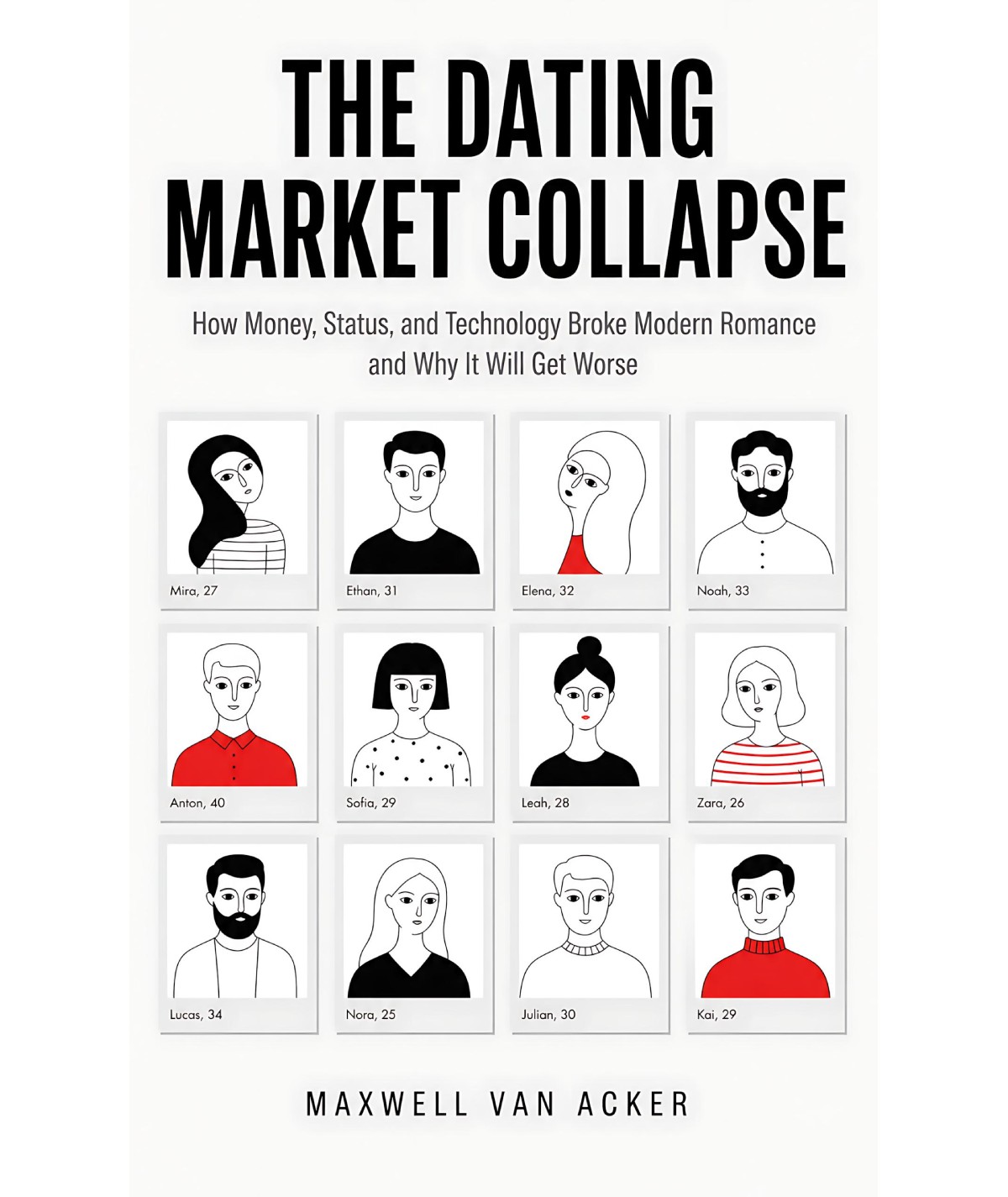
Modern dating has never offered more choice, yet stable relationships have never felt more uncertain. Dating apps promise access to endless possibilities. Social media displays idealized relationships. Economic independence and technological change appear to expand freedom. Yet beneath this apparent abundance lies a quieter reality: pairing has become more difficult, commitment more fragile, and long-term stability increasingly rare.
The Dating Market Collapse examines how modern romance evolved into a system that increasingly resembles a marketplace. Where relationships once formed inside stable social networks, they are now shaped by algorithms, visibility, economic signals, and large-scale comparison. Profiles function as listings, attention operates as currency, and perceived value often outweighs genuine compatibility.
Rather than offering dating advice or quick solutions, this book provides a structural analysis of how modern dating works. It explores how technology encourages optimization instead of connection; why perceived abundance creates decision paralysis; and how rejection at scale reshapes behavior and expectations. It examines how social media inflates standards, how economic uncertainty alters attraction, and how substitutes for intimacy reduce the motivation to pursue relationships.
The book also analyzes the asymmetries and incentives shaping modern behavior. It explains why commitment increasingly feels risky; why expectations diverge between participants; and why withdrawal from dating can become a rational response rather than a personal failure. These patterns are treated not as moral problems but as predictable outcomes of changing systems.
Looking forward, the book explores how artificial intelligence, economic transformation, and potential post-scarcity conditions may further reshape romance. As traditional sources of status and provision weaken, attraction may become less mediated by economic exchange and more dependent on intrinsic compatibility. This transition may produce fewer relationships but potentially more stable ones.
The Dating Market Collapse is written for readers interested in social change, behavioral incentives, and the future of relationships. It will appeal to readers of social theory, psychology, and cultural analysis who want a deeper understanding of why dating feels increasingly unstable.
This is not a book about blaming individuals. It is a book about systems. It argues that modern dating reflects the incentives and technologies that shape it, and that meaningful change requires understanding those structures rather than moralizing about personal behavior.
By treating romance as a social system rather than a collection of personal stories, The Dating Market Collapse offers a clear and intellectually grounded framework for understanding one of the defining social changes of the modern era.